The Best ChatGPT Rank Tracking Tools, and Why the App and the API Disagree
We asked the ChatGPT app and OpenAI's API the same 20 buying questions. They shared half their brands. Here is what that means when you choose a ChatGPT rank tracking tool.
By Richard Castro · November 24, 2026 · 10 min read
The best ChatGPT rank tracking tool is one that reads answers the way your buyers see them, then repeats the check often enough to trust the number. Otterly and Peec AI suit daily tracking, Morningscore is the narrow ChatGPT-only option, SE Ranking and Semrush fit teams already in those suites, and AnalySEO is the low-cost choice tied to Search Console.
Before you compare dashboards, ask one question: does the tool read the ChatGPT app, or OpenAI's API? We sent the same 20 buying questions to both. The app agreed with itself 89% of the time. The API, with web search on, shared only 50% of its brands with the app.
Prices checked 1 November 2026 on each vendor's own page, unless we say otherwise. AnalySEO is our product. It is in the comparison with its limits listed, and it uses the API, which this test puts in question.
A ChatGPT tracker that reads the wrong version of ChatGPT measures something your buyers never see.
What a ChatGPT rank tracker measures
ChatGPT has no fixed list of ten results. It writes a new answer each time, so "rank" stands for three separate things:
- Mentions. Did the answer name your brand?
- Citations. Did it link to your page as a source?
- Order. Were you named first, or fifth?
A tracker sends a fixed set of prompts on a schedule, stores each answer and turns those three counts into rates over time. We covered how that works across all engines, and how many answers each plan buys, in our guide to LLM rank tracking tools. This post is about ChatGPT alone, because ChatGPT has a problem the others mostly share but rarely discuss.
There are two ways to get a ChatGPT answer by machine:
- The app. What a person sees at chatgpt.com. To track it, a tool has to load the page and read it, which vendors call scraping or UI capture.
- The API. OpenAI sells model access to developers. It is cheaper and easier to automate, and you can switch web search on or off. It is not the app. The model, the hidden instructions and the way it searches can all differ.
If the two give the same answers, the method does not matter. So we checked.
We asked the app and the API the same 20 questions
On 24 November 2026 we wrote 20 buying questions of the kind a small business might ask, such as "What is the best CRM for a small business?" and "What is a cheaper alternative to Semrush?". The last one was about our own market: "What are the best tools to track brand mentions in ChatGPT?".
Each question went five ways, all through DataForSEO, from the US:
- The ChatGPT app, three times. Logged out, with no history. All three runs came within ten minutes.
- The API with web search on, once. Model gpt-6-sol.
- The API with web search off, once. Same model, answering from what it learned in training.
That is 100 answers. We also pulled Google's top 10 for each question, to see where ChatGPT's sources come from. The research cost $1.47 in total.
We counted brands with a fixed list for each question, so "HubSpot CRM" and "HubSpot" count as one brand. Overlap is the share of brands two answers have in common, out of all the brands either one named.
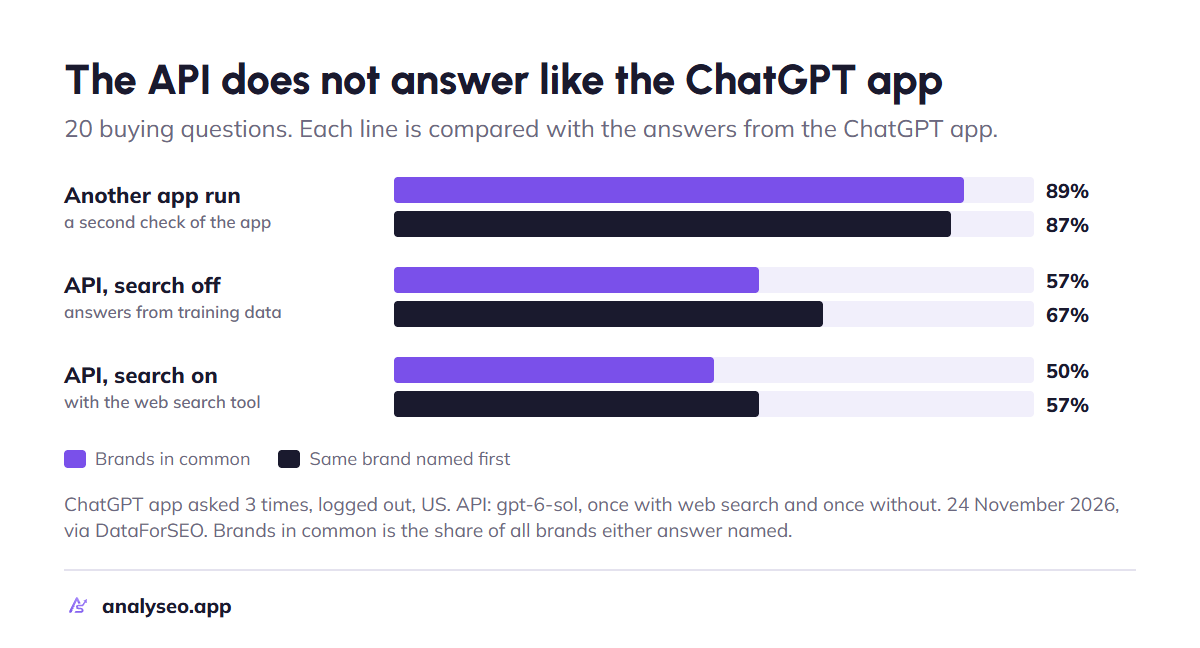
| Compared with the ChatGPT app | Brands in common | Same brand named first | Brands per answer |
|---|---|---|---|
| Another run of the app | 89% | 87% | 5.6 |
| API, web search off | 57% | 67% | 3.9 |
| API, web search on | 50% | 57% | 3.4 |
What we found
The app was steady. Two runs of the same question shared 89% of their brands, and 16 of the 20 questions had the same first brand in all three runs. On 15 questions, at least one pair of runs named exactly the same brands.
That is far steadier than our earlier test. When we asked the API the same question five times for the LLM rank tracking guide, two runs shared between 50% and 70% of their brands. That test used an older model, GPT-5.5, so the two are not a clean comparison. Still, the pattern fits: the noise we blamed on ChatGPT was partly noise from the API.
The API named fewer brands. The app named 5.6 brands per answer on average. The API named 3.4 with search on and 3.9 with it off. Shorter answers mean fewer chances to appear, so a brand that sits fifth in the app can vanish completely in an API check.
Most of the gap was missing brands, not new ones. We took the 100 brands the app named in all three runs, the ones you would call safe. The API with search on left out 44 of them. Of the 68 brands it did name, only 8 never appeared in any app answer.
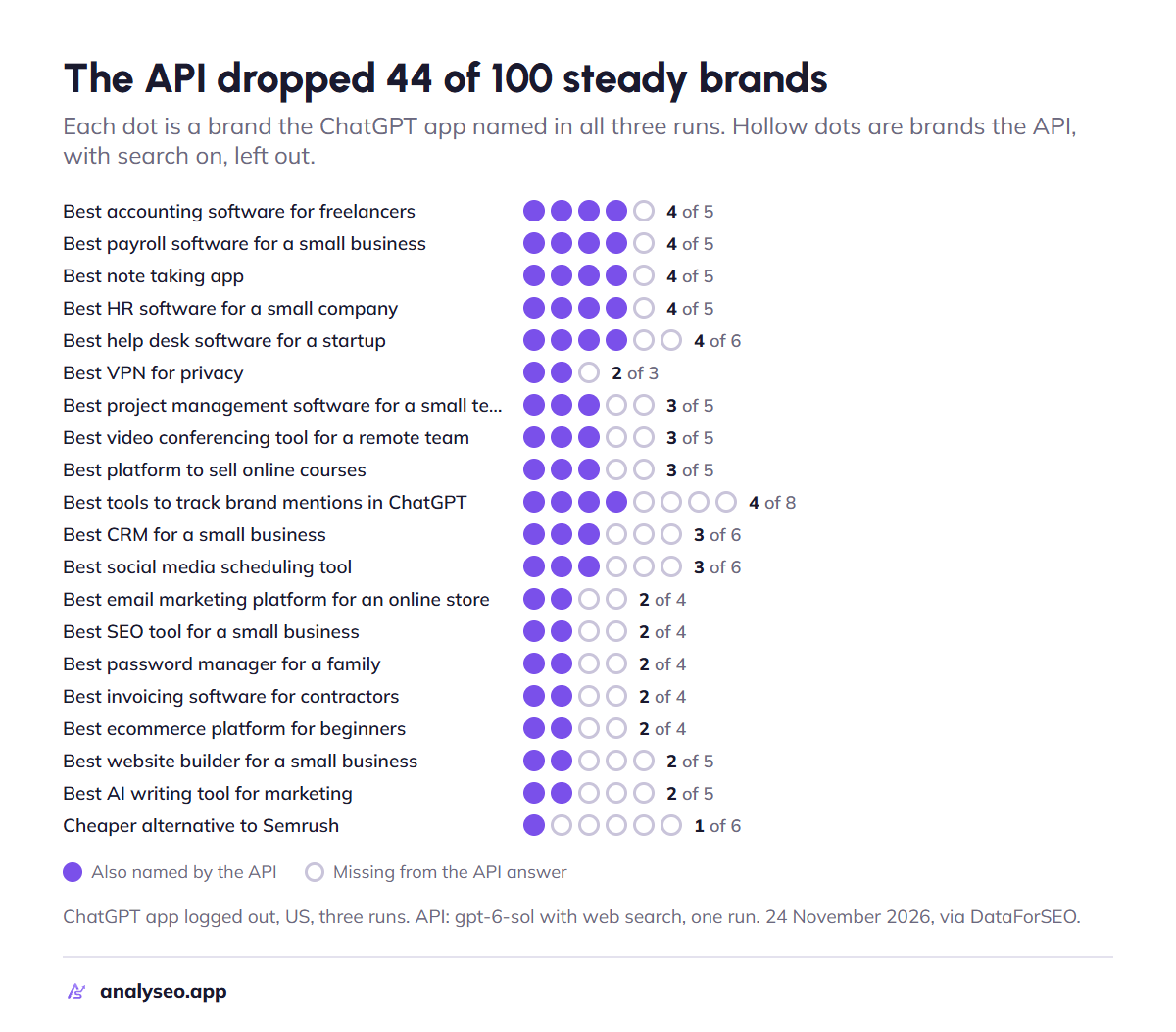
The cuts were not random. The API kept the leaders and cut the middle. On "a cheaper alternative to Semrush", the app named SE Ranking, Mangools, Ubersuggest, SpyFu and two free Google tools every time. The API named SE Ranking and Ahrefs. If you sell Mangools, an API tracker would report that ChatGPT ignores you, while real users see you named in every answer.
Search on was further from the app than search off. We expected the reverse. With search off, the API matched the app's first brand on 67% of comparisons. With search on, 57%. On "the best SEO tool for a small business", the app led with Semrush in two runs and SE Ranking in the third, while the API led with Google Search Console both times.
The first brand still changed often. Across 20 questions, the API with search on put a different brand first on 9 of them, compared with the app's first run. On note taking, the app said Notion, the API with search said OneNote, and the API without search said Obsidian.
Why the two disagree: they read different pages
The answers differ because the searches behind them differ.
- The app ran one broad search per answer. For example, "best CRM software for small businesses 2026 comparison pricing features". It then read about 11 pages, mostly review sites and comparison lists such as Capterra, G2, TechRadar and a long tail of small affiliate blogs, and cited about 8.
- The API ran about 7 searches per answer, and 89% of them were limited to one site. Searches like "site:pipedrive.com/en/pricing Pipedrive pricing plans". It went straight to the vendors' own pricing pages and cited about 3 sources.
So the app summarises what review sites say, and the API checks the facts on the brands it already had in mind. Both are reasonable, but they produce different shortlists. For your visibility work, that matters: in the app, the pages that decide whether you are named are mostly third-party lists, not your own site.
Very few of those pages rank on page one of Google. Across the three app runs, ChatGPT read 674 pages. Only 17 of them, 2.5%, were in Google's top 10 for the same question. When we searched Google for the exact phrase ChatGPT itself searched, it was 1.3%. Ranking in Google does not put you in front of ChatGPT, which matches what we saw in our benchmark of 100 SEO queries and in our AI Overview tracker test.
Other studies found a bigger gap
Several vendors have run the same comparison, and most found the gap wider than we did:
- Surfer compared scraped ChatGPT answers with API results across 1,000 prompts and reported about 24% brand overlap and about 4% source overlap.
- Brandlight reported about 11% brand overlap for ChatGPT across 834 matched prompts.
- An arXiv preprint covered by Search Engine Journal found that Google results and OpenAI's API together recovered 26.2% of the pages ChatGPT cited, and 48.7% of the sites.
The first two come from companies that sell AI visibility tracking, so read them with that in mind. Our 50% is higher, probably because our questions were common product categories with a few obvious leaders, and because we compared brand names rather than exact sources. On sources, we agree with them: the app and the API read different pages.
What this test does not show
This is 20 questions on one day, from one country, logged out, with one API model and one API run per setting. The three app runs came within ten minutes, so the app may move more over days and weeks than it did here. A logged-in user with memory and history may see something else again. Brand counting used a fixed list per question, which can miss a brand we did not expect. Read the numbers as a direction, not a market measurement.
What to ask before you pay for a ChatGPT tracker
Our test leaves four questions to ask any vendor:
- Do you read the ChatGPT app or call the API? If the API, ask whether web search is on, which model you use, and how you know it reflects the app.
- Logged in or out, and from where? Answers change with location. A US check says little about buyers in Spain.
- How many runs per prompt? The app was steady in our test, so daily checks of a fixed prompt set are worth more than many single checks of random prompts.
- Do you keep the sources? The pages ChatGPT read are where the work is. A tracker that only shows a mention rate tells you the score, not how to change it.
Few vendors put the answer to the first question on their pricing page. Writesonic, for one, says in its documentation that it monitors the real platforms rather than only APIs. For the tools below, we did not confirm the method, so ask.
The ChatGPT rank tracking tools compared
Every tool here tracks ChatGPT. The difference is how many answers you get per month and what else comes with them.
| Tool and plan | Price a month | Prompts | Engines | Refresh |
|---|---|---|---|---|
| AnalySEO Free | $0 | 15 | 5 | 1 manual scan |
| AnalySEO Standard | $26 | 15 | 5 | 8 manual scans |
| Otterly Lite | $29 | 15 | 4 | Daily |
| Morningscore Lite | $69 | 10 | ChatGPT only | Weekly |
| LLMrefs All in One | $79, limited time | 500 | 9 | Weekly |
| Peec AI Starter | $95 | 50 | 3 of 6 | Daily |
| SE Ranking Core | $129 | 25 | 5 | Daily |
| Semrush Starter | $199 | 50 | Not fully named | Daily |
Otterly is the cheapest daily option we checked. Lite covers 15 prompts, and the next plan jumps to $189 for 100.
Morningscore is the only one built around ChatGPT alone. Weekly runs of 10 prompts give you about 43 answers a month, which is thin, so read it as a trend over months.
LLMrefs covers the most engines and collects the most answers at its price, but weekly. Check that the $79 price still holds.
Peec AI runs 50 prompts daily on 3 engines of your choice. Pick ChatGPT as one of them if that is where your buyers ask.
SE Ranking includes 25 daily prompts in its Core suite plan. If you would buy the suite anyway, the tracking comes almost free.
Semrush suits teams already working there. Starter gives 50 daily prompts on one domain.
Ahrefs sells checks rather than prompts, where one check is one prompt on one platform. Its Lite plan includes 150, and packages of 2,500 checks start at $50, according to TechRadar. Profound also has a ChatGPT-only entry plan listed by third parties at $99 for 50 prompts, but we could not confirm it is still sold.
Where AnalySEO fits, and where it does not
We build AnalySEO's AI visibility tracking, so weigh this section with that in mind.
What it does well. Every plan, including Free, sends 15 questions to 5 engines and keeps each answer with its sources. It reports mentions and citations separately and shows who was cited instead of you. The main difference is the link to Search Console: a gap appears next to the pages already earning impressions on that topic, so you know which page to work on.
What it does not do.
- It reads ChatGPT through the API, with web search on. That is the setup that matched the app least in this test, so treat our ChatGPT numbers as a signal of what the model knows, not as a copy of what users see.
- Scans are manual. They run when you press Analyze, never on a schedule.
- Each question runs once per scan. Compare several scans before you act on a change.
Choose it if you already work from Search Console and want a list of pages to fix. Choose a daily tracker that reads the app if a ChatGPT trend line is what you report on.
How to check ChatGPT by hand
You can run a small version of our test in an hour, for free:
- Write 10 to 15 buying questions your customers ask, without your brand name in them.
- Open a private browser window and ask each one at chatgpt.com without logging in.
- Ask each question three times, in a fresh window each time.
- Log every brand named, in order, and the sources it links to.
- Count how often you appear, and note which sites ChatGPT read when you did not.
If your result matches across the three runs, that is your baseline, and a tracker only needs to watch for changes. If it does not, you need a tool with more runs per prompt.
What to do next
Run the hand check on your 10 most valuable questions, and write down which review sites and lists ChatGPT read. Those pages, not your Google position, decide whether you are named. Getting onto them is the work, and our GEO guide covers how.
When you compare tools, ask the four questions above and put the answer to "app or API?" first.
See where you stand across ChatGPT and four other engines. Start free with AnalySEO, with 15 questions and no card, and compare it with your hand check.
Frequently asked questions
What is a ChatGPT rank tracker?
A tool that sends a fixed set of prompts to ChatGPT on a schedule and records whether your brand is mentioned, cited and how early it appears. The result is a rate over many answers, not a fixed position.
Do ChatGPT trackers show what real users see?
Only if they read the ChatGPT app. In our test of 20 questions, the API with web search shared 50% of its brands with the app, while two app runs shared 89%. Ask each vendor which method it uses.
How do I rank in ChatGPT?
Get onto the pages ChatGPT reads. In our test, the app read mostly review sites and comparison lists, and only 2.5% of those pages were in Google's top 10 for the same question.
Is ChatGPT's answer the same every time?
In the logged-out app, mostly yes for common product questions: two runs shared 89% of their brands and the first brand matched 87% of the time. API answers varied more.
What is the cheapest way to track ChatGPT visibility?
By hand: ask 10 to 15 questions three times each in a private window and log the brands. Among tools, AnalySEO is free for one scan a month and Otterly Lite is $29 for daily runs.