The Best LLM Rank Tracking Tools, Compared by What They Measure
We asked ChatGPT the same questions five times and the lists kept changing. Here is what that means for LLM rank tracking tools, with prices, engines and the answers each plan buys.
By Richard Castro · November 7, 2026 · 10 min read
The best LLM rank tracking tool is the one that collects enough answers to trust its chart. Otterly and Peec AI suit daily tracking, LLMrefs covers the most engines, Semrush fits existing Semrush teams, and AnalySEO is the low-cost option tied to Search Console. One run proves nothing.
Most lists of these tools compare dashboards. They skip the question that decides whether any dashboard means something: how much does the answer change when you ask again? We tested that with 15 runs in ChatGPT, then worked out how many answers each plan actually buys.
Prices checked 1 November 2026 on each vendor's own page, unless we say otherwise. AnalySEO is our product, and it appears in this comparison with its limits listed.
One answer is an anecdote. A tracker is only worth what the number of answers behind its chart allows.
What LLM rank tracking actually measures
An LLM does not keep a ranked list of ten results. It writes a new answer each time, so "rank" here is a loose word for three separate things:
- Mentions. Did the answer name your brand at all?
- Citations. Did it link to your page as a source? This is the part that can send a click.
- Position. How early in the answer did you appear, compared with competitors?
A tracker sends a fixed set of prompts to each engine on a schedule, stores the answers and counts those three things. The output is a rate, such as "named in 40% of answers", and a rate is only as steady as the sample behind it.
This is also why your Google position does not answer the question. In our benchmark of 100 SEO queries, where Google showed a tool vendor, the brands LLMs cited appeared in its top 10 only 19.8% of the time. How to earn those citations is a separate job, covered in our GEO guide.
We asked ChatGPT the same question five times
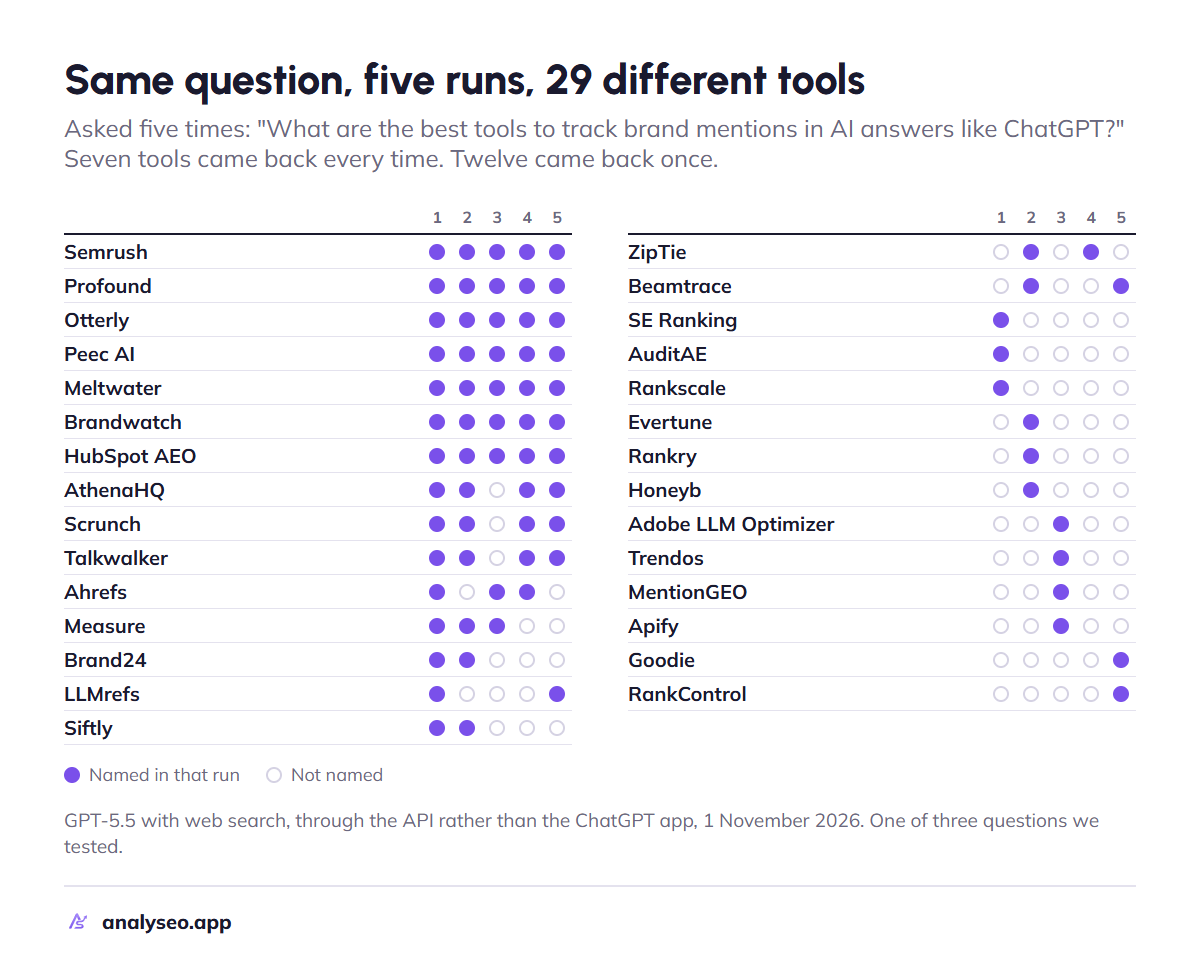
We sent three buying questions to GPT-5.5 with web search on, five times each, within five minutes on 1 November 2026. It cost $1.43. Then we counted every brand named in each answer.
| Question | Brands across 5 runs | In every run | In one run only | Average overlap between two runs |
|---|---|---|---|---|
| What are the best tools to track brand mentions in AI answers like ChatGPT? | 29 | 7 | 12 | 50% |
| What are the best SEO tools for a small business? | 20 | 8 | 1 | 62% |
| What is a cheaper alternative to Semrush? | 9 | 4 | 0 | 70% |
Overlap is the share of brands two runs have in common. Semrush is left out of the third row because it is in the question.
What stayed still and what moved
The first name never changed. Search Console, Profound and SE Ranking were named first for their questions in all five runs. If you lead a category, one check will probably show it.
The tail is close to random. Two runs of the tracking question shared as little as 35% of their brands, and 12 of the 29 tools appeared once and never again.
Big names drop out too. Ahrefs sells a tracker and appeared in three of five answers. SE Ranking also sells one and appeared in one. Judging either from a single check would give you the wrong picture.
AnalySEO appeared in none of the 15 runs. That matches our benchmark. We are not yet a brand these answers reach for.
This is a small test on one model, through the API rather than the ChatGPT app, with no personal history and one location. Read it as an illustration of the problem, not a measurement of the market.
What sample size does to the chart
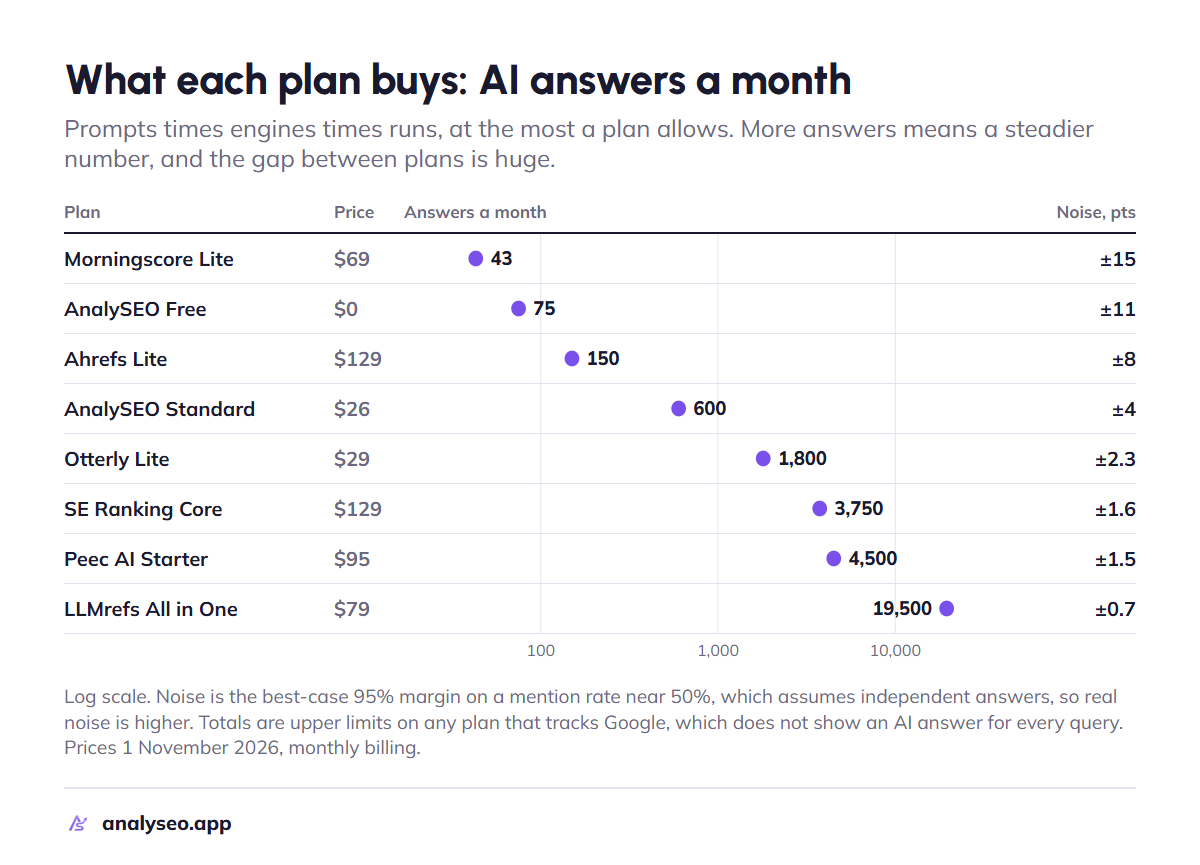
If a brand is named about half the time, basic statistics puts a floor on the noise. With 75 answers, the margin is about 11 points either way. With 600 it is 4, and with 4,500 it is 1.5. That is the best case, because it assumes every answer is independent, and repeats of one prompt are not.
So on a 75-answer scan, a move from 40% to 45% tells you nothing. Keep that in mind when a vendor shows you a weekly up arrow.
Which LLMs to track
Track the engines your buyers use, and treat each one separately. A Muck Rack report covered by Axios ran the same 1,020 prompts through ChatGPT, Claude, Gemini and Perplexity and found major differences in their sources, so one blended score can hide a gap.
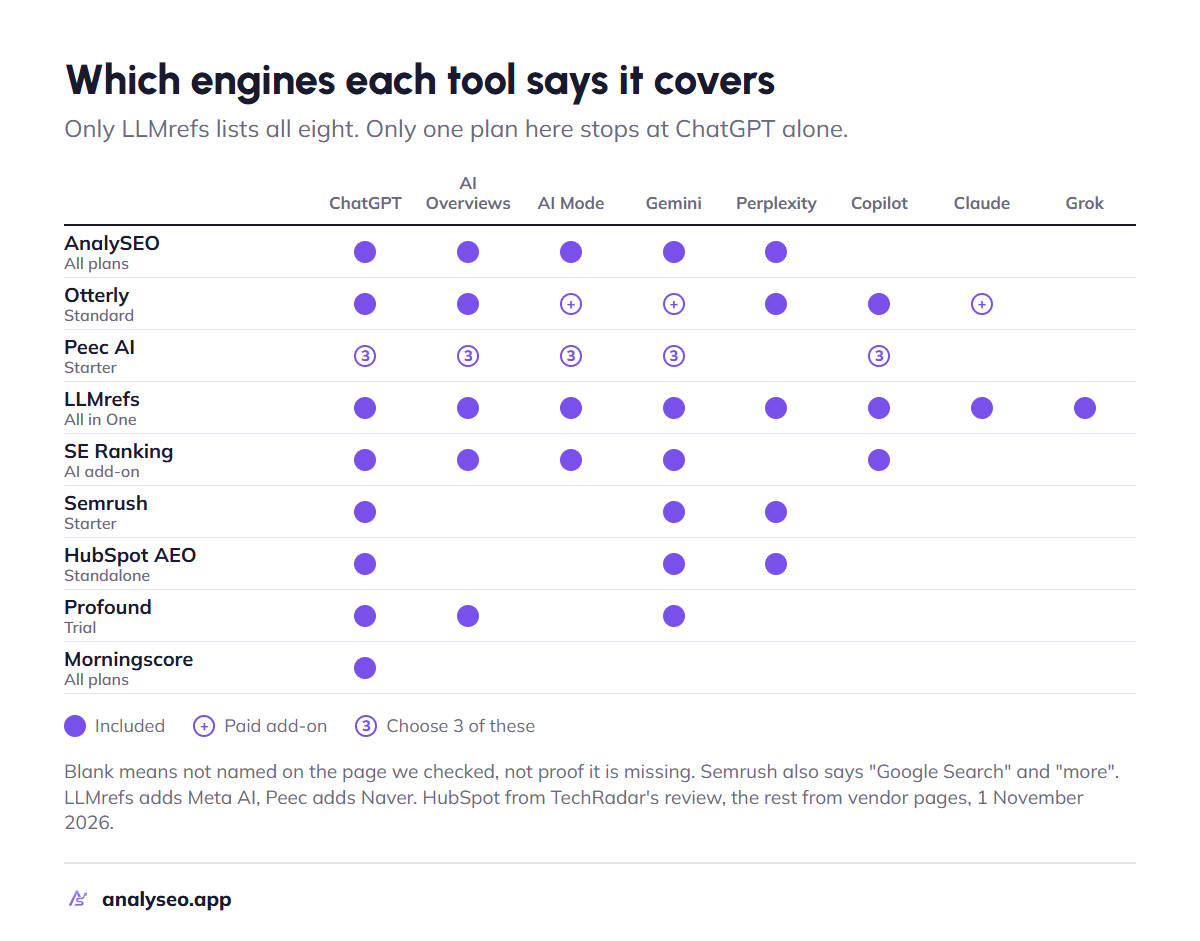
A sensible default for most businesses is ChatGPT plus Google's two surfaces, AI Overviews and AI Mode. Add Perplexity and Gemini if your buyers are researchers or already live in Google's apps. Add Copilot if you sell to Microsoft-heavy companies. Pay for Claude or Grok when you have a reason to think your buyers use them, not to fill a grid.
Two questions to ask any vendor before paying:
- API or interface? Some tools query the engine's API, others capture what the app shows, and the two can differ. AnalySEO uses the APIs for ChatGPT, Gemini and Perplexity, and reads Google's two surfaces from live results.
- What happens when no answer appears? Google does not show an AI answer for every query. A tool should report that as missing, not as a lost mention.
The top LLM rank tracking tools, by what each plan buys
To compare plans fairly, we multiplied prompts by engines by runs per month. A month is 30 days for daily plans and 4.33 weeks for weekly ones.
| Tool and plan | Price a month | Prompts | Engines | Refresh | Answers a month |
|---|---|---|---|---|---|
| AnalySEO Free | $0 | 15 | 5 | 1 manual scan | Up to 75 |
| AnalySEO Standard | $26 | 15 | 5 | 8 manual scans | Up to 600 |
| Otterly Lite | $29 | 15 | 4 | Daily | About 1,800 |
| Morningscore Lite | $69 | 10 | 1 | Weekly | About 43 |
| LLMrefs All in One | $79, limited time | 500 | 9 | Weekly | About 19,500 |
| Peec AI Starter | $95 | 50 | 3 of 6 | Daily | 4,500 |
| SE Ranking Core | $129 | 25 | 5 | Daily | About 3,750 |
| Ahrefs Lite | $129 | Sold as checks | Not named | Varies | 150 checks |
| Semrush Starter | $199 | 50 | Not fully named | Daily | 1,500 per engine |
More answers is not automatically better. LLMrefs spreads its total across 500 prompts run weekly, while Peec AI runs 50 prompts daily. Breadth finds more topics, and repetition gives a steadier number per topic.
Dedicated trackers
Otterly is the cheapest daily tracker we checked, and it beats our own Standard plan on answers for $3 more. Its catch is 15 prompts on Lite, and the jump to Standard is steep, at $189 for 100 prompts. AI Mode and Gemini are $59 add-ons each on that plan.
Peec AI suits a team that wants daily data on one clear prompt set. Starter includes unlimited seats. You choose 3 engines from 6, and Perplexity is only listed on Enterprise.
LLMrefs has the widest coverage and the largest sample at its price. Data refreshes weekly, and the $79 price is marked as limited time, so check it before you plan around it.
Profound is built for enterprise teams. It offers a 7-day trial of 50 daily prompts on ChatGPT, Gemini and AI Overviews. We did not find its self-serve prices on the page we checked, so ask before assuming they fit your budget.
Inside an SEO suite
Semrush makes sense if your team already works there. The $139 SEO plan monitors custom prompts without stating a count, and Starter at $199 gives 50 daily prompts on one domain.
SE Ranking includes 25 daily prompts across 5 engines in its $129 Core plan. If you were going to buy the suite anyway, this is hard to beat. A standalone AI add-on starts at $71.
Ahrefs counts checks rather than prompts, where one check is one prompt on one platform in one location. Lite includes 150, which is thin for tracking. Packages add 2,500 checks for $50, and Brand Radar AI starts at $199.
Narrow options
Morningscore tracks ChatGPT only, weekly, from $69. HubSpot AEO tracks ChatGPT, Gemini and Perplexity for $50 a month, according to TechRadar's review, and is most convenient if you already run on HubSpot. We did not confirm its price or prompt limit on HubSpot's own page. Cheaper trackers exist that we did not check, so treat this list as a start rather than the whole market.
Where AnalySEO fits, and where it does not
We build AnalySEO's AI visibility tracking, so weigh this section accordingly.
What it does well. Every plan, including Free, sends 15 questions to the same 5 engines. It reports mentions and citations separately, keeps each answer with its sources, and shows who was cited instead of you. The main difference is the link to Search Console: a gap arrives next to the pages already earning impressions on that topic, so you can see which page to edit first. For how that differs from pasting your data into a chatbot, see AnalySEO vs ChatGPT for SEO.
What it does not do.
- Scans are manual. They run when you press Analyze, never on a schedule, so a missed week is a gap in your history.
- Each question runs once per scan. A single scan has up to 75 answers and the 11-point margin above. Compare several scans before you act.
- No Copilot, Claude or Grok. If those matter to you, choose LLMrefs.
- A smaller sample. Standard tops out at 600 answers, and Otterly collects about 1,800 for $3 more.
Choose it if you already work from Search Console and want to know what to fix. Choose a dedicated tracker if the trend line is the thing you report on.
How to set up tracking
The setup matters more than the tool, because you cannot fix a bad prompt set later without breaking your history.
- Write 15 to 50 buyer questions. Start from your real Search Console queries and rephrase them as questions. Leave your brand name out, since branded prompts only measure whether engines recognise you.
- Freeze the wording. A changed prompt is a new data series.
- Name 3 to 5 competitors. A rate only makes sense next to someone else's.
- Take a baseline from several runs. Average at least three before you record a starting point.
- Read monthly, by engine. Weekly moves are mostly noise unless your sample is large.
- Check the sources behind each answer. That is where the work is. A September 2026 preprint with 34,960 observations found mention rates of 2.8% on GPT and 3.8% on Gemini when neither the brand nor its domain was in the retrieved sources, against 49.0% and 58.4% when the brand's own domain was cited. It is observational and single-author, but it points to the same place: get into what the engines read.
When a tracker is not worth paying for yet
If you have fewer than a few hundred organic visits a month, fix that first, because you will not have the pages to act on what a tracker finds. If nobody on the team has time to edit pages, a chart will only make you feel worse.
Before you pay, do it by hand. Take 15 questions, ask each one three times with search on, and log whether you are named. It takes about an hour and tells you whether the bigger picture is worth a subscription.
What to do next
Run the hand check above on your 15 most valuable questions, and count how many brands repeat across your three runs. That number tells you how much sample you need, and so which plan to look at.
Then decide what the data is for. If it is a trend line for a report, buy repetition. If it is a list of pages to fix, you need the link to your own search data more than you need volume.
Track your LLM visibility. Start free with AnalySEO, with 15 questions across 5 engines and no card, and compare your first scan against the hand check.
Frequently asked questions
What is LLM rank tracking?
It means sending a fixed set of prompts to engines such as ChatGPT and Gemini on a schedule, then recording whether your brand is mentioned, cited and how early it appears. The result is a rate over many answers, not a fixed position.
How accurate are LLM rank trackers?
They are good for trends and weak for single readings. In our test, two runs of the same question shared as little as 35% of their brands. A 75-answer sample has at least an 11-point margin, so small moves are noise.
Which LLMs should I track?
Start with ChatGPT, Google AI Overviews and AI Mode. Add Perplexity and Gemini if your buyers use them, and Copilot for Microsoft-heavy companies. Report each engine separately, because they rely on different sources.
How often should prompts run?
Daily runs give a steadier number, while weekly runs are enough for most small sites. Read the results monthly whatever the cadence, because weekly moves on a small sample are mostly noise.
What is the cheapest way to track LLM visibility?
A manual check is free: ask 15 questions three times each and log the results. Among the tools we checked, AnalySEO is free for one scan a month and $26 for eight, and Otterly Lite is $29 for daily runs.
Can I just check ChatGPT myself?
Yes, as a starting point. Ask each question several times with search on, because one answer is not reliable. It stops scaling once you need many prompts, several engines or a history to compare against.