The Best AI Overview Trackers, and What They Actually Check
We ran 20 Google searches and only 15% of the sources AI Overviews cited ranked on page one. How AI Overview trackers compare on price, refresh and citation data, and what Search Console shows for free.
By Richard Castro · November 20, 2026 · 9 min read
An AI Overview tracker checks your keywords on a schedule and records whether Google showed an AI Overview and whether your page was cited in it. Seobility and SE Ranking do this for the least money, Semrush and Advanced Web Ranking go deeper, and Search Console now shows part of it for free.
Rank is not a stand-in for that second question. We ran 20 Google searches and found that most of the sources an AI Overview cited did not rank on page one for the same search. So you cannot read your AI Overview presence off a normal rank report. It has to be checked directly.
Prices checked 7 November 2026 on each vendor's own page, monthly billing, unless we say otherwise. AnalySEO is our product. It is not a keyword rank tracker, and we say below where it fits.
Ranking in the top 10 and being cited in the AI Overview are two different results. A tracker has to measure the second one on its own.
What an AI Overview tracker measures
A useful tracker answers four questions for every keyword:
- Did Google show an AI Overview? Not every search triggers one, and the same search can show one today and not tomorrow.
- Is your page cited? This is a link to your site among the sources, which is what can send a click.
- Where in the source list? Being the first source or the ninth is not the same thing, the way position 1 and position 9 differ in blue links.
- Who else is cited? Competitors that show up again and again are the ones to study.
Some tools only answer the first question. They flag that "an AI Overview appears" next to your keyword and stop there. That tells you the space exists, not whether you are in it. When you compare tools, the column that matters is whether they record your citation.
An AI Overview tracker is narrower than an LLM tracker. It works from your keyword list on Google, where an LLM rank tracking tool sends questions to ChatGPT, Gemini, Perplexity and others. If your buyers live on Google, start here.
We ran 20 searches to see what gets cited
On 7 November 2026 we ran 20 common searches about marketing software and SEO, from the United States on desktop, and pulled the full results page for each one twice, a few minutes apart. Some were buying searches like "best crm for small business", others were questions like "how long does seo take".
Every one of the 20 searches had an AI Overview. Three of them came back as a placeholder the first time, an answer Google loads after the page, with no text and no sources yet. A tracker that reads only the first load would log those three as "no AI Overview" when there was one.
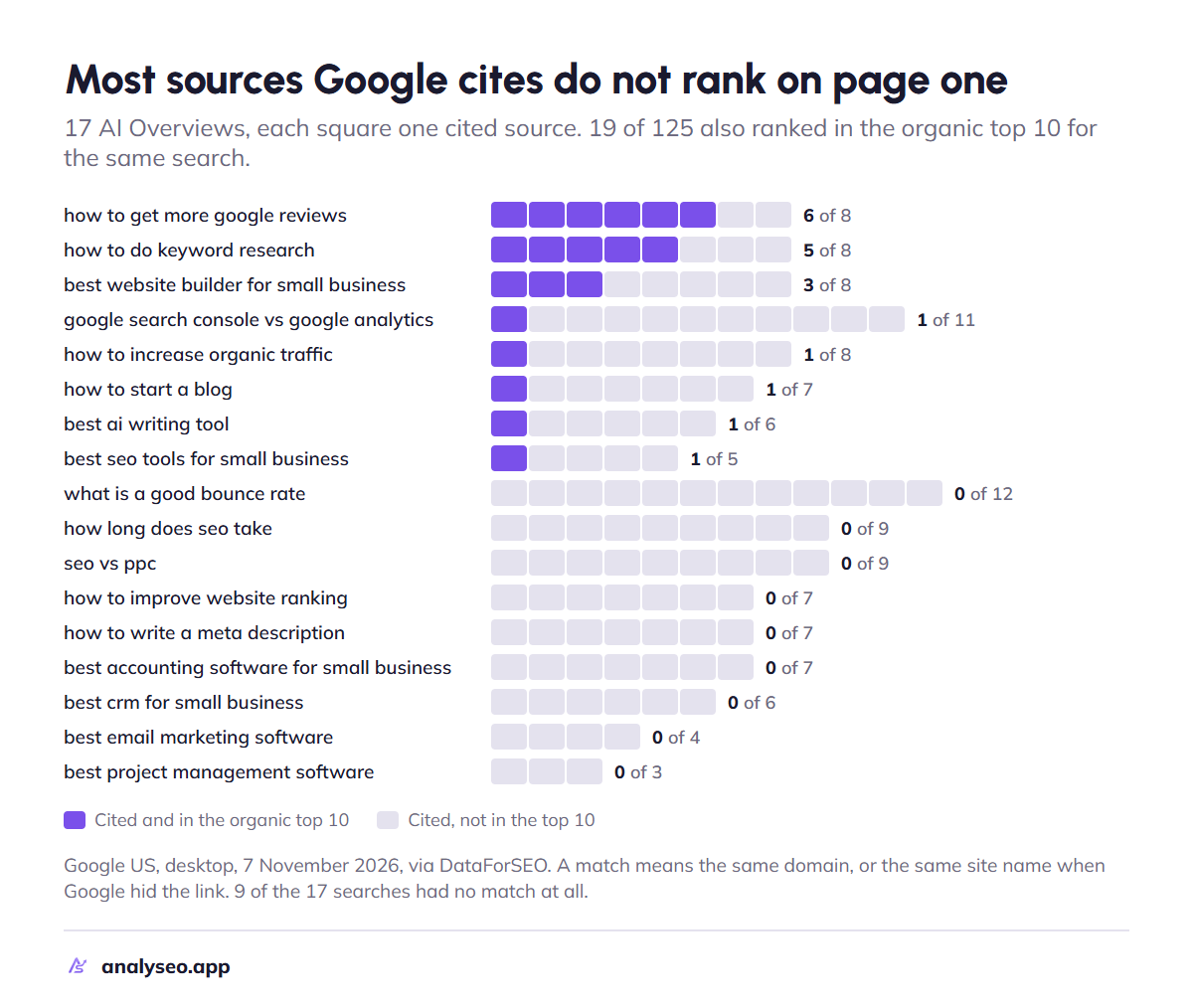
For the 17 that loaded fully, we compared the cited sources with the organic top 10 for the same search.
| What we counted | Result |
|---|---|
| Sources cited across the 17 AI Overviews | 125 |
| Of those, also ranking in the organic top 10 | 19, or 15% |
| Of those, ranking in the top 3 | 8 |
| Searches where no cited source ranked in the top 10 | 9 of 17 |
| Cited links that came back as a Google redirect, hiding the site | 55 of 157, or 35% |
| Searches whose cited sources were the same a few minutes later | 16 of 17 |
What the numbers say
Page one does not predict the citation. Only 15% of what Google cited also ranked in the top 10, and in 9 searches not a single source did. Two searches, "how to get more google reviews" and "how to do keyword research", account for 11 of the 19 matches. Counting a Reddit thread or YouTube video as a match even when it was a different thread or video than the one ranking raises the share to 22%. It is still a minority.
That fits larger studies. BrightEdge put the top 10 share near 17% across 2025. Ahrefs found 38% in March 2026, down from 76% a year before, partly because its method changed. The direction is the same everywhere: a page one ranking helps, but most citations come from elsewhere.
A third of cited links hide the site. In the raw results, 35% of the links Google cited pointed to a google.com redirect, not to the site's own address. Every search with a loaded AI Overview had at least one. The real address can be recovered, but only if the tool follows the redirect. If it does not, it can miss your citation and report you as absent.
Checking twice in an hour adds nothing. The cited sources were identical a few minutes later in 16 of 17 searches. Over days it is a different story. Ahrefs tracked 43,000 keywords for a month and found the text changed about every 2.15 days, with 45.5% of cited sources new from one check to the next. Daily refresh is the useful rhythm. Weekly misses most of the movement.
What Search Console shows you for free
Google added a Generative AI performance report to Search Console in June 2026 and rolled it out to every site by 31 August 2026. It counts how many times links to your site appeared in a generative AI feature on Google Search.
It is a real step forward, and it has limits:
- It reports impressions only. No clicks.
- It breaks data down by page, country, date and device. It does not show the searches that triggered the impression.
- It mixes AI Overviews and AI Mode in one number, with no filter to separate them.
- In the main Performance report, AI Overview and AI Mode traffic stays mixed into ordinary Web results.
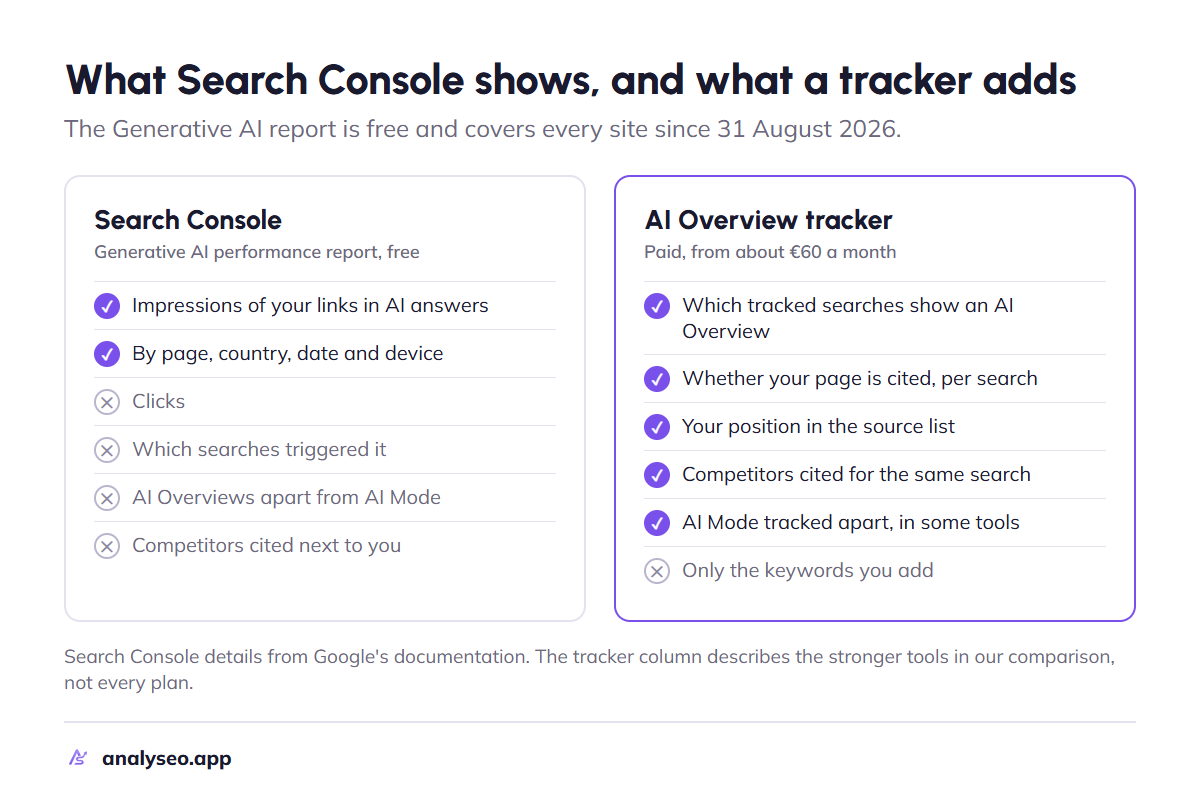
So Search Console answers "which of my pages appear in AI answers, and is that growing?" A tracker answers "for which searches, in which position, and who else is there?" Start with the free report. If a page shows AI impressions, you know there are searches worth tracking, and its regular query report hints at which ones. Our guide to finding the keywords that matter in Search Console covers that step.
The AI Overview trackers compared
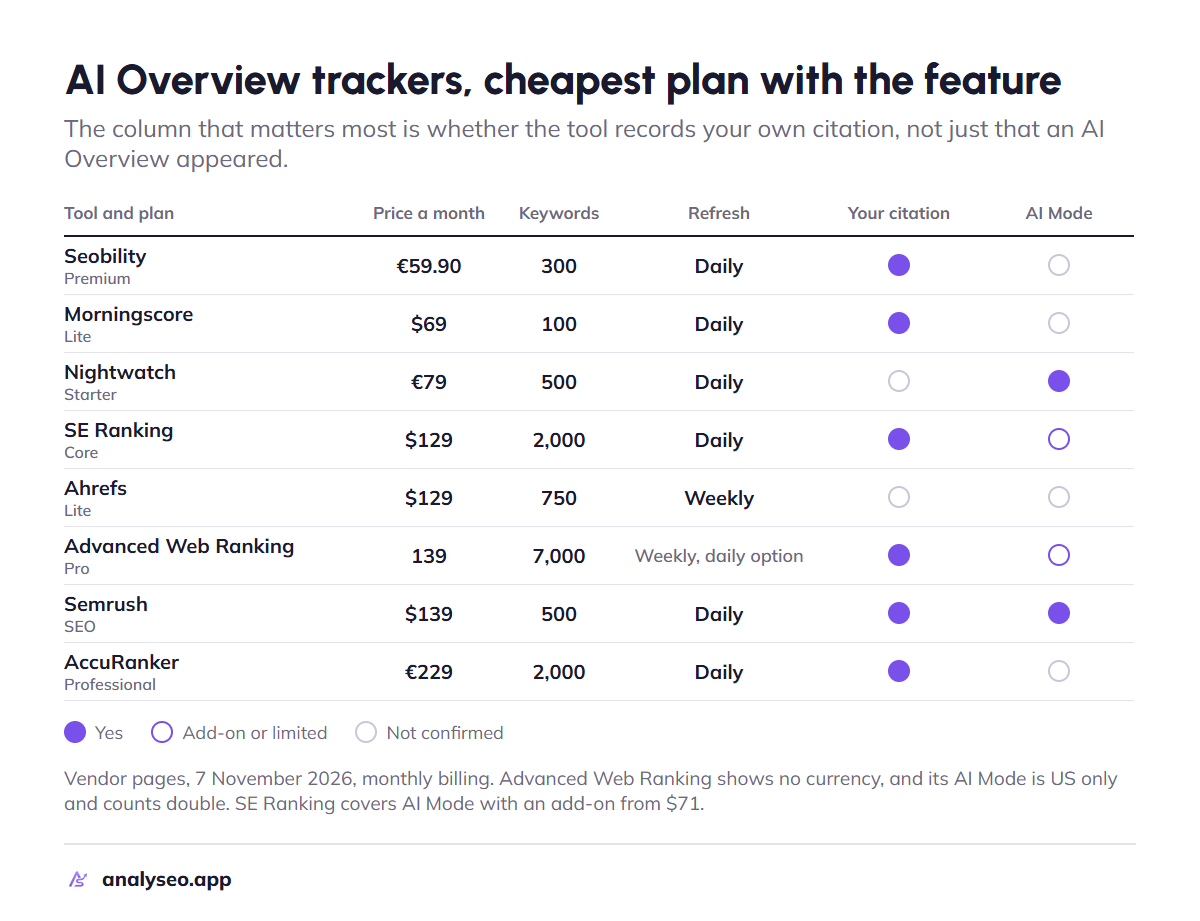
These are keyword rank trackers that check AI Overviews alongside the normal results. We list the cheapest plan that includes AI Overview tracking.
| Tool and plan | Price a month | Keywords | Refresh | Records your citation | AI Mode |
|---|---|---|---|---|---|
| Seobility Premium | €59.90 | 300 | Daily desktop, mobile every 3 days | Yes, with position | Not mentioned |
| Morningscore Lite | $69 | 100 | Daily | Yes | Not mentioned |
| Nightwatch Starter | €79 | 500 | Daily | Not confirmed | Listed |
| SE Ranking Core | $129 | 2,000 | Daily | Yes | Paid add-on, from $71 |
| Ahrefs Lite | $129 | 750 | Weekly | Not confirmed in Rank Tracker | Not mentioned |
| Advanced Web Ranking Pro | 139 | 7,000 | Weekly, daily available | Yes, with citation rank | Yes, US only, counts double |
| Semrush SEO | $139 | 500 | Daily | Yes | Yes |
| AccuRanker Professional | €229 | 2,000 | Daily | Yes | Not confirmed |
Advanced Web Ranking's pricing page shows no currency. AccuRanker and SE Ranking do not say which plan first includes AI Overview tracking, so we list their entry plans for that keyword volume.
Best for a small budget: Seobility and Morningscore
Seobility is the cheapest tool here that records whether your site is cited and in which position, at €59.90 for 300 keywords. Its free Basic plan tracks 10 keywords but only shows whether an AI Overview appears. Morningscore includes AI Overview tracking in every plan, from $69 for 100 keywords checked daily. Fewer keywords, simpler interface.
Best value per keyword: SE Ranking
SE Ranking Core tracks 2,000 keywords daily for $129, on desktop and mobile, and records whether you are cited. Its free tool checks 5 keywords a day for presence only. AI Mode, ChatGPT and other engines need the separate AI visibility add-on, from $71.
Best for depth: Advanced Web Ranking and Semrush
Advanced Web Ranking goes furthest on the citation itself. It reports an AI Overview citation rank and a metric for how much AI and organic results overlap, and it tracks AI Mode as its own engine in the US, where each keyword counts twice against the quota. Refresh is weekly by default, so pay for daily if you want the trend.
Semrush marks your citation in Position Tracking and lets you pick Google AI Mode as the search engine, so both are tracked daily in one tool. If you already pay for Semrush, check this before buying anything else. Semrush says AI Overview tracking works on any plan, the free one included, though we could not confirm the free keyword limit.
Worth knowing about
Ahrefs shows AI Overviews among the SERP features in Rank Tracker, refreshed weekly on Lite. We could not confirm that Rank Tracker flags your own citation per keyword, though Site Explorer has a filter for it. Ahrefs also runs a free AI Overviews tracker, in limited preview and with no signup. AccuRanker marks keywords where your domain is among the cited URLs as "Owned", from €229 for 2,000 keywords. Nightwatch lists AI Overviews among the SERP features it tracks from €79, but we could not confirm a per-keyword citation flag.
Where AnalySEO fits, and where it does not
AnalySEO does not track a list of keywords. It asks a fixed set of 15 questions across five engines, Google AI Overviews and AI Mode among them, and records whether your brand is mentioned, whether your domain is cited and in which position among the sources. The free plan runs one full scan a month. Standard is $26 for eight scans across up to two sites. Scans are started by hand, not on a daily schedule.
That makes it a fit for one job: seeing whether Google's AI answers, and the other engines, mention you for the questions your buyers ask, next to your Search Console data. See the AI visibility feature for what a scan returns.
It is the wrong choice if you need 300 keywords checked every morning. For that, Seobility, SE Ranking or Semrush are built for the job.
How to set up AI Overview tracking
- Open the Generative AI report in Search Console. Note which pages already get AI impressions. Those are your starting points.
- Pick 30 to 100 keywords. Take the searches behind those pages, plus the questions that bring you leads. Skip searches that never show an AI Overview.
- Track daily if you can. AI Overviews change every few days, so a weekly check catches a fraction of the movement.
- Test the tracker on a known citation. Find a search where Google cites you today, add it, and check that the tool reports it. With a third of cited links arriving as redirects, this is the quickest way to catch a tool that misses citations.
- Read it monthly. Look at the share of tracked keywords where you are cited, not at single days.
When a tracker is not worth paying for yet
If Search Console shows no AI impressions for any page, a tracker will mostly confirm that you are absent. Spend the money on the pages first: answer the question in the opening lines, keep facts current and earn mentions on sites Google already cites. Our guide to generative engine optimization covers that work. Come back to tracking once the report shows movement.
What to do next
Open Search Console and look at the Generative AI performance report today. It is free and takes five minutes. If your pages appear, choose a tracker by the column that matters, whether it records your citation, and test it on one search where you know you are cited. If you also want to know what ChatGPT, Gemini and Perplexity say about you, the comparison of LLM rank tracking tools covers the trackers that check them.
Frequently asked questions
What is an AI Overview tracker?
A tool that checks your keywords on Google on a schedule and records whether an AI Overview appeared, whether your page was cited as a source and in which position. Many rank trackers now include it alongside normal rankings.
Can Google Search Console track AI Overviews?
Partly. Since 2026 its Generative AI performance report shows impressions of your links in AI features, by page, country, date and device. It shows no clicks or searches, and it does not separate AI Overviews from AI Mode.
Is there a free AI Overview tracker?
Search Console's Generative AI report is free. Ahrefs runs a free AI Overviews tracker in limited preview, Seobility's free plan checks 10 keywords and SE Ranking's free tool checks 5 a day, though both free plans only show whether an AI Overview appears.
How often should I check AI Overviews?
Daily if you can. Ahrefs found the text changes about every 2.15 days and almost half the cited sources change between checks. Checking more than once a day adds little: in our test, sources were the same a few minutes later in 16 of 17 searches.
Does ranking in the top 10 get you into the AI Overview?
It helps, but most cited sources do not rank there. In our 20 searches, only 15% of cited sources were also in the organic top 10, and BrightEdge measured about 17% over 2025.
What is the difference between an AI Overview tracker and an LLM tracker?
An AI Overview tracker checks your keyword list on Google. An LLM tracker sends questions to ChatGPT, Gemini, Perplexity and others. If most of your buyers search on Google, start with AI Overviews.