AI Search Visibility Benchmark: Which SEO Brands Do LLMs Actually Cite?
We ran 100 SEO-category queries through a corpus of language-model answers and counted every brand cited, then pulled Google's top 10 for the same queries. Three brands take 56% of all mentions, and the two channels barely agree. The full dataset is open.
By Richard Castro · September 17, 2026 · 7 min read
We ran 100 real SEO-category queries through DataForSEO's LLM mentions corpus and counted every brand cited. Then we pulled Google's organic top 10 for the same 100 queries and compared.
The ranking is the least interesting thing we found.
Our own product, AnalySEO, was mentioned zero times. So were DinoRank, SEOptimer, SearchAtlas and Sistrix. That is the honest starting point for everything below, and it is part of why we ran this in the first place.
---
What we measured
- 100 queries, split across seven intents: category discovery, alternatives, concrete tasks, head-to-head comparisons, audience segments, AEO/GEO, and price.
- 444 distinct brand strings returned (437 once case variants are merged), 11,654 raw mentions. After cleaning: 271 brands, 9,706 mentions.
- 947 organic results pulled from Google for the same queries.
- Market: United States, English. Date: September 2026.
Full query list and methodology at the end. Nothing here is behind a signup.
---
Finding 1: three brands own more than half the category
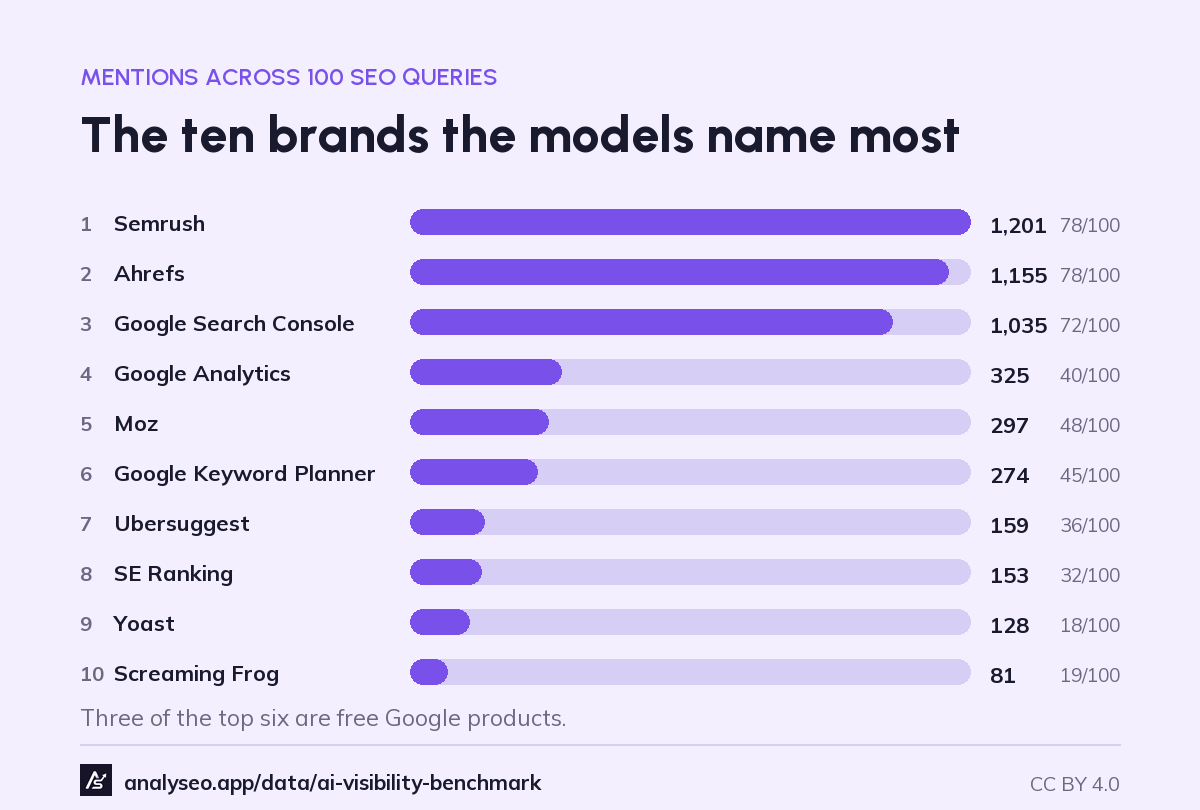
| # | Brand | Mentions | Appears in |
|---|---|---|---|
| 1 | Semrush | 1,201 | 78 of 100 queries |
| 2 | Ahrefs | 1,155 | 78 of 100 queries |
| 3 | Google Search Console | 1,035 | 72 of 100 queries |
| 4 | Google Analytics | 325 | 40 of 100 |
| 5 | Moz | 297 | 48 of 100 |
| 6 | Google Keyword Planner | 274 | 45 of 100 |
| 7 | Ubersuggest | 159 | 36 of 100 |
| 8 | SE Ranking | 153 | 32 of 100 |
| 9 | Yoast | 128 | 18 of 100 |
| 10 | Screaming Frog | 81 | 19 of 100 |
The top 3 take 56% of all mentions. The top 10 take 79.3%. Of the 255 tool brands we counted, 103 were mentioned exactly once.
Two things worth sitting with.
Three of the top six are free Google products. Search Console, Analytics and Keyword Planner together account for 1,634 mentions, more than Semrush or Ahrefs individually. When an LLM answers a question about SEO, its most common recommendation is a tool that costs nothing.
Semrush edges out Ahrefs, barely. Both appear in 78 of 100 queries. The gap is 4%, which is inside the noise. Treat them as tied.
---
Finding 2: Google ranks articles about tools. LLMs cite the tools.
This is the one that changes how you should think about the two channels.
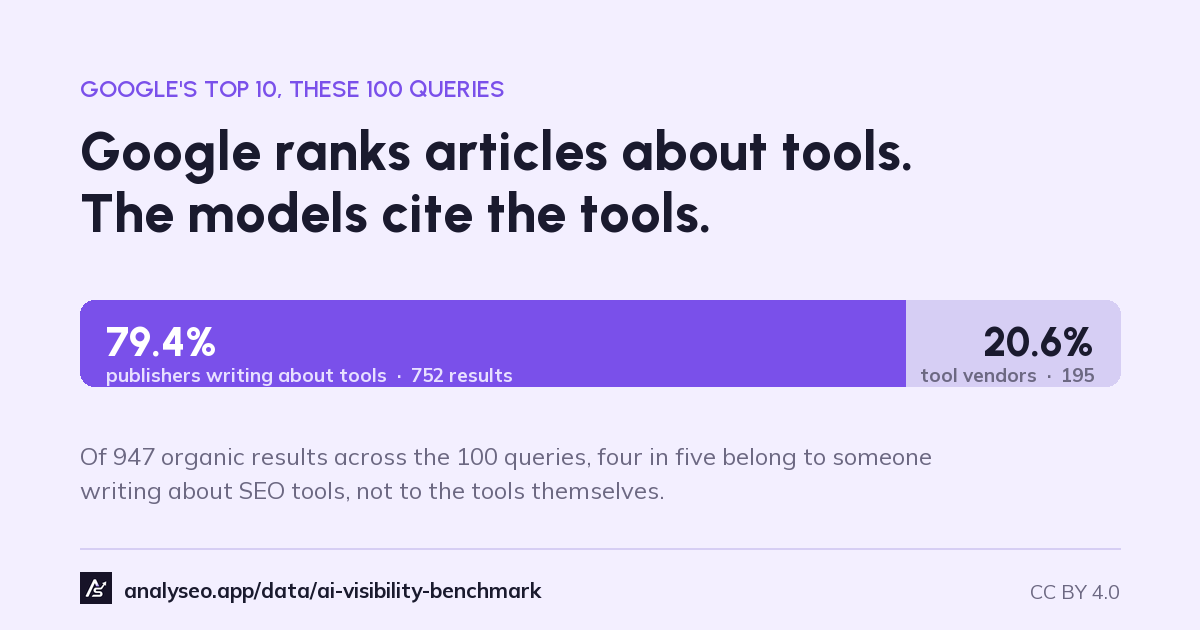
Of the 947 organic results we pulled from Google across these queries:
- 79.4% were publishers writing about tools: listicles, reviews, roundups, Reddit threads.
- 20.6% were the tool vendors' own domains.
LLMs do the opposite. They almost never name the publisher. They name the tool.
Take best seo tools. The only tool domain in Google's top 10 is surferseo.com. The LLM answer cites Ahrefs, Google Search Console and Semrush. None of them rank on that page.
We tested the overlap properly. Restricting to only the 76 queries where Google does surface at least one tool domain in its top 10, which is the most favourable possible comparison, the top brands cited by LLMs appear in Google's top 10 just 19.8% of the time. In 38% of those queries the overlap is zero.
The practical consequence: ranking a blog post about your category is not how you get cited in AI answers. A publisher can own the SERP for "best SEO tools" without the model ever repeating their list. These are two distributions, and winning one does not hand you the other.
---
Finding 3: LLMs confuse website platforms with SEO tools
We excluded these from the ranking above, but the numbers are too large to leave out of the article:
| Platform | Mentions |
|---|---|
| Wix | 759 |
| WordPress | 717 |
| Shopify | 636 |
| Squarespace | 541 |
| WooCommerce | 277 |
| BigCommerce | 196 |
Wix alone was mentioned more often than Moz, Ubersuggest and SE Ranking combined.
These are website builders and ecommerce platforms, not SEO tools. They surface because model answers about "SEO tools" routinely slide into platform recommendations: "if you're on Wix, use their built-in SEO panel". The category boundary that is obvious to a practitioner is not obvious to the model.
If you sell an SEO tool, you are competing for citation space against Wix.
---
Finding 4: nobody owns the AI-search category yet
This is the most useful thing in the dataset.
We included 10 queries about AEO and GEO: tracking brand mentions in ChatGPT, appearing in AI Overviews, monitoring AI search visibility. Here is what the models cited:
| Query | Brands cited |
|---|---|
| how to track brand mentions in chatgpt | Brandspot, Profound |
| ai visibility tracking tools | Ahrefs, Semrush, HubSpot |
| generative engine optimization tools | Google Search Console, Atomic |
| how to optimize for chatgpt search | ChatGPT, OpenAI, Jasper AI |
| tools to monitor ai search visibility | Google Search Console, Ahrefs |
| how to rank in perplexity | Anthropic, OpenAI, ByteDance |
| llm seo tools | Atomic, Atomic AGI |
| how to measure ai search traffic | Atomic, Atomic AGI |
| geo seo tools | none |
Across all 10 AEO/GEO queries, Ahrefs was mentioned 10 times and Semrush 9, against 1,155 and 1,201 across the full set. In the category that everyone claims is the future of search, the incumbents have less than 1% of their usual presence.
One query returned no brands at all. Several returned model vendors: OpenAI, Anthropic and ByteDance, because the models have nothing better to name.
The AI-search tooling category has no established brand. Every other part of this map is locked up by three companies. This part is open.
---
What this means for your LLM SEO
If you are a tool vendor: your Google rankings are not a proxy for AI visibility, and you cannot infer one from the other. Measure them separately or you are flying blind on a channel you are already losing.
If you are writing content: the model cites products, not publishers. A roundup that ranks first on Google may never be repeated by a model. Being named in the roundups that models were trained on matters more than owning the SERP.
If you are picking a category to compete in: the concentration in established SEO tooling is brutal, with 56% of mentions going to three brands. The AEO/GEO category is, right now, empty.
---
Methodology
Source. Brand mentions come from DataForSEO's LLM mentions corpus (llm_mentions/top_mentioned_brands), aggregated across model responses rather than from single live prompts. This matters: aggregating over a corpus avoids the run-to-run non-determinism that makes one-shot prompting unreliable. Organic results come from DataForSEO's Google SERP API, top 10, United States, English.
Query selection. 100 queries across seven intent blocks: discovery (18), alternatives (16), tasks (22), comparisons (12), segments (12), AEO/GEO (10), price and free (10). Weighted by intent rather than search volume, because a citation benchmark measures the contexts in which brands get named, not demand. No query contains a year, so the same list can be rerun quarterly and compared.
Cleaning. Three passes, all of which changed the results:
- Case variants merged. "SEMrush" and "Semrush" were counted separately by the API (647 and 554). Merged, Semrush moves from 5th to 1st. The same applied to Moz/Moz Pro and Surfer/Surfer SEO.
- Generic phrases removed. The API returns descriptors as brands. "SEO software company" accumulated 267 mentions and would have placed 12th. Removing generics dropped 9% of raw mentions.
- Platforms separated. Wix, WordPress, Shopify and similar were pulled out of the tool ranking and reported separately in Finding 3.
The Google comparison. Our first attempt compared LLM-cited brands against all Google top-10 domains and produced a 17.2% overlap. That number was an artifact: most Google results are publishers, so of course tool brands were absent. The 19.8% figure reported above restricts the comparison to queries where Google surfaces at least one tool domain, which is the fairer test.
Who counts as a tool vendor. A result counts as the vendor's own domain only if it is the product's site. Google's own documentation, meaning developers.google.com/search and support.google.com, counts as a publisher, because a starter guide about doing SEO is somebody writing about the work, not a product page. That is 21 of the 947 results, and the brand-to-domain map we used is published with the data so you can classify them differently and see what moves.
---
What this study does not claim
- It does not measure market share, revenue or product quality. It measures how often a brand is named.
- It is not a sample of "all AI". It is one corpus, with its own coverage and biases, and it is not independently reproducible by a third party. That is a real limitation.
- 100 queries cover the category; they do not exhaust it.
- It is a single point in time. The value of this benchmark comes from the second edition, when there is movement to report.
- We publish it as the makers of an SEO tool that received zero mentions in it.
---
The data
Everything behind this article is published in full, under CC BY 4.0:
| File | Rows | What it holds |
|---|---|---|
00-queries.csv | 100 | The query list with its intent block |
01-brand-ranking.csv | 271 | Every brand, with mentions split by block |
02-mentions-by-query.csv | 1,763 | Every mention, query by query, before filtering |
03-google-serp.csv | 947 | Google's organic top 10 for the same queries |
04-brand-domains.csv | 36 | The brand-to-domain map behind the overlap number |
The unfiltered file is the important one. Every brand we removed as a generic descriptor is still in there, flagged, so you can redo the cleaning differently and see whether the conclusions hold. We think they do. Check.
It all lives on one page: analyseo.app/data/ai-visibility-benchmark, with the five CSVs, the raw API responses, the full method and the licence.
We will rerun the same 100 queries quarterly, so the next edition is comparable to this one.
Frequently asked questions
Which AI models does this benchmark cover?
It draws on an aggregated corpus of language-model responses supplied by DataForSEO, not a single named model. That is a real limitation: you cannot use it to say that one particular assistant prefers a given brand. What it does show is which brands dominate model-generated answers about SEO tools in general.
Why not prompt an AI assistant 100 times and count the answers?
Because the same prompt returns different brands on different runs. A single-shot benchmark measures sampling temperature as much as it measures the brand landscape. Aggregating over a corpus is the less exciting method and the more defensible one.
Do Google rankings predict whether an AI will cite you?
Barely. Across the 76 queries where Google surfaces at least one tool vendor in its top 10 — the most favourable possible comparison — the brands cited by language models appear in that top 10 only 19.8% of the time, and in 38% of those queries the overlap is zero. They are two different distributions.
Which SEO brand is cited most by AI?
Semrush, with 1,201 mentions across the 100 queries, just ahead of Ahrefs at 1,155. Both appear in 78 of the 100 queries, so the 4% gap is inside the noise. Treat them as tied. Google Search Console is third at 1,035.
Is the data free to download?
Yes. Five CSV files and the raw API responses are published under CC BY 4.0 at analyseo.app/data/ai-visibility-benchmark, with no signup. That includes the unfiltered mention file, so you can redo our cleaning and check whether the conclusions hold.
Who owns the AEO and GEO tooling category?
Nobody, yet. Across the ten AEO/GEO queries, Ahrefs was mentioned 10 times and Semrush 9, against 1,155 and 1,201 across the full set — under 1% of their usual presence. One query returned no brands at all.