SEO Competitor Analysis: The Practical Method
Most competitor analysis guides start by opening a paid tool. This one starts in your own Search Console, because the competitors you name and the ones Google ranks above you are rarely the same list.
By Richard Castro · October 15, 2026 · 6 min read
An SEO competitor analysis compares your site against the sites that actually take the clicks you want, so you can see what they rank for that you do not and decide what to fix first. The useful version starts from your own Search Console data, not from a list of brands you consider rivals.
Most guides on this topic start the same way: open a paid tool, type in a competitor, export a list. That works, and it also skips the part that decides whether the whole exercise is worth anything. If you pick the wrong competitors, every number after that is precise and useless.
Your real competitors are rarely the ones you name
Ask a founder who they compete with and you get the companies they lose deals to. Ask Google and you get a different list, because Google ranks pages, not companies.
A content site you have never heard of can sit above you on half your commercial queries. A direct rival with a better product may not appear at all, because they never wrote about the thing people search for. Neither fact shows up in a sales conversation.
This matters more than it used to. When we measured which brands language models cite across 100 SEO-category queries, 79.4% of Google's results were publishers writing about tools, not the tools themselves. The pages competing for your queries are often not your business competitors at all.
Finding them in your own data
Search Console gives you the list for free, and it is the only list based on queries you actually appear for.
- Open Performance, set the date range to the last three months, and switch to the Queries tab.
- Sort by impressions and take the top 20 to 30 queries that describe what you sell. Ignore brand queries: nobody competes with you for your own name.
- Search each one and write down every domain in the top ten.
- Count. The domains that appear across many of your queries are your search competitors, whatever your sales team calls them.
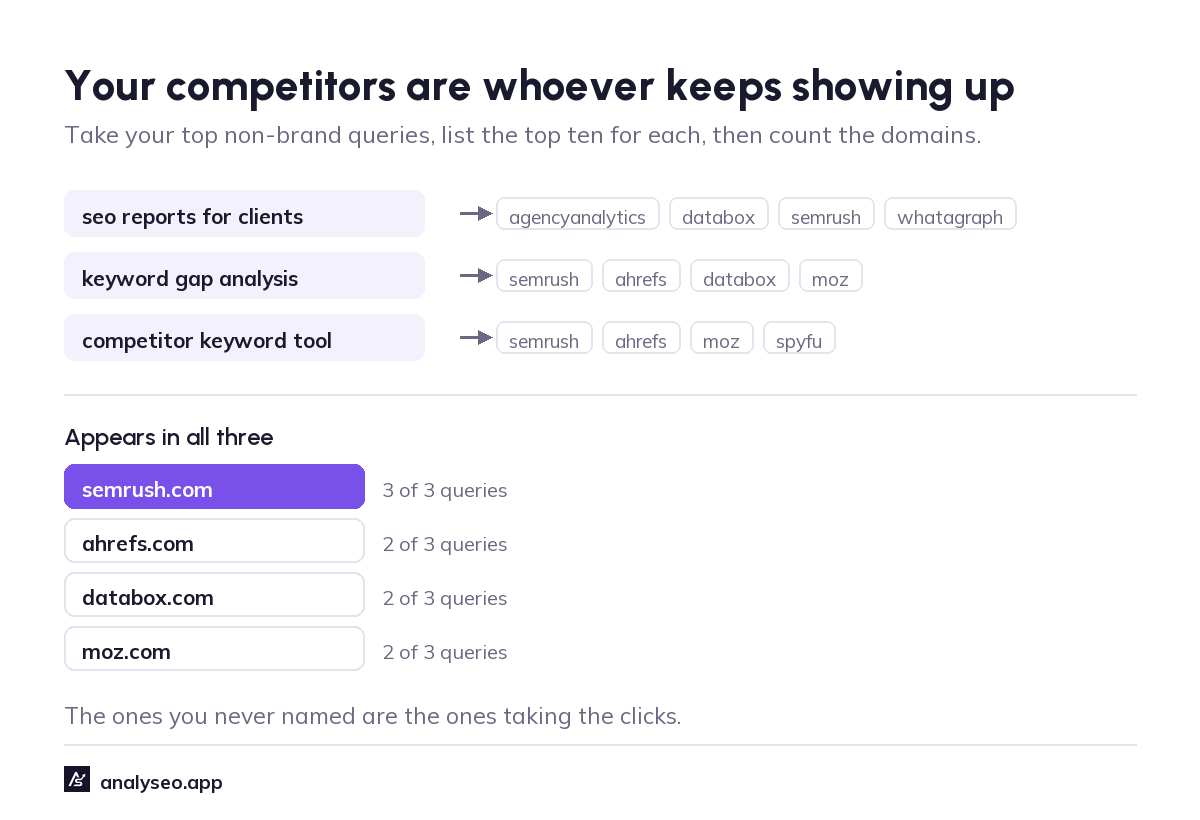
That list is usually a surprise. It tends to contain two or three names you expected, several publishers, and at least one site that has no business ranking and does anyway.
If your Search Console is new or thin, start with the queries you already appear for and work with whatever you have. Twenty queries is enough to see the pattern.
What is worth comparing, and what is noise
Once you have the list, the temptation is to compare everything. Resist it. Most competitor dashboards are a wall of metrics where nothing suggests an action.
| Worth comparing | Why it leads somewhere | Mostly noise |
|---|---|---|
| Queries where they rank and you do not | Tells you what to write or improve | Domain authority scores |
| Queries where you both rank, and the positions | Tells you what to improve first | Total traffic estimates |
| The page they rank with, and its format | Tells you what Google rewards here | Follower counts |
| Who links to that page | Tells you where the authority came from | Their posting frequency |
The pattern is simple: compare things that name a page or a query, because those turn into tasks. Comparing aggregate scores produces a feeling, not a plan.
The keyword gap, from your own numbers
The keyword gap is the set of queries your competitors rank for and you do not. Every paid tool sells this as a button. You can get the part that matters without one.
Start from the queries you already appear for, because those are the ones where you have standing. In Search Console, filter the Queries tab to positions 11 to 30. These are queries where Google already considers you relevant and you are one page short of being seen. We have written up the full method for striking distance keywords, and it is the fastest part of any competitor analysis.
For each of those queries, look at who is above you and ask one question: what does their page have that yours does not? Usually it is one of four things.
- Format. They wrote a comparison table and you wrote prose, or the reverse.
- Specificity. Their page answers the exact query. Yours answers a broader topic that includes it.
- Freshness. Their prices, screenshots or figures are current and yours are two years old.
- Depth on one point. They go deep on the thing the searcher actually wanted and treat the rest briefly.
Only after that is it worth exporting a full gap list from a paid tool. By then you know what you are looking for, which is the difference between a useful export and a spreadsheet nobody opens.
Two gaps that are traps
Queries where they rank and you never will. A query that returns Wikipedia, a government page and three sites with thousands of referring domains is not a gap, it is a wall. Note it and move on.
Queries with the wrong intent. If a query looks commercially attractive but the results are all free tools and your product is paid, the clicks will not convert. We left an entire cluster alone for exactly this reason after seeing it hold position four with zero clicks.
The backlink gap, and when to skip it
Look at the specific page that outranks you, not at the competitor's whole domain. Domain-level link comparisons tell you that a big site is big. Page-level comparisons tell you which five or six sources decided a single result.
What you are looking for is the pattern, not the count: are those links from reviews, from a study everyone cites, from a directory, from a community thread? That pattern is reproducible. A raw number is not.
Skip this part entirely if your site is young. With a thin link profile, the answer to every page-level comparison is "they have more links", and you already knew that. Your time goes further on format and specificity, which you control today.
Turning the gap into a plan
A competitor analysis that ends in a document has failed. The output should be a short ordered list where each line names a page and an action.
Order it by effort against evidence of standing, not by search volume:
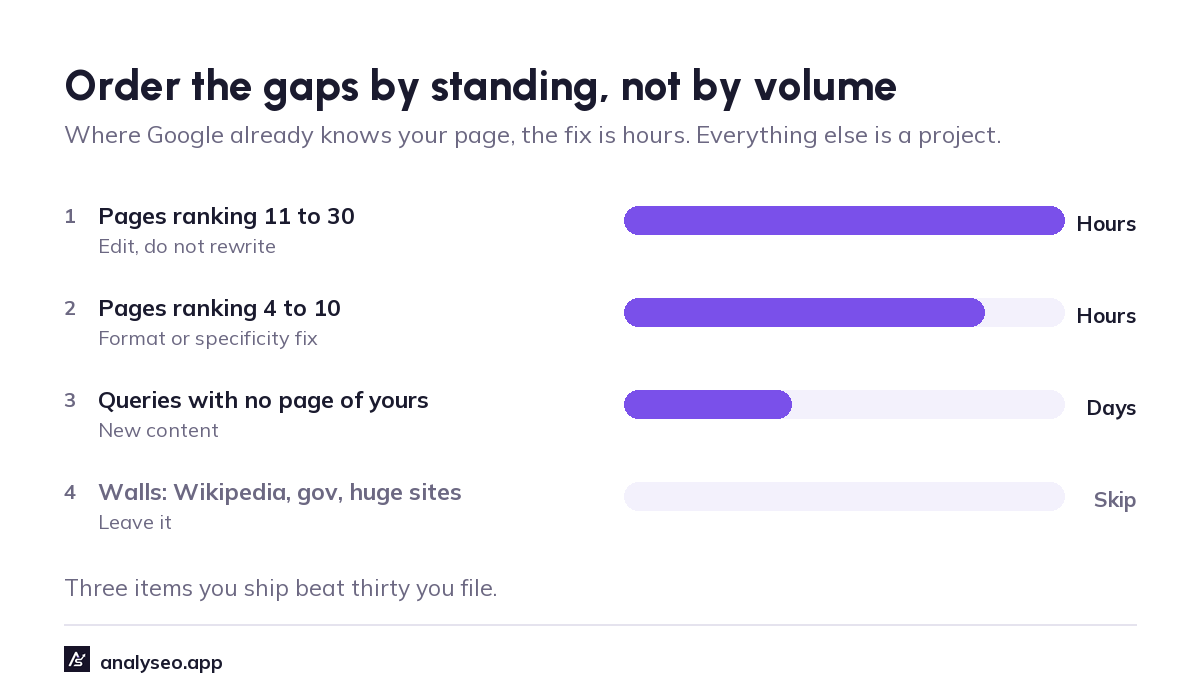
- Pages you already have, ranking 11 to 30. Edit, do not rewrite. Hours of work, and Google already knows the page.
- Pages you already have, ranking 4 to 10. Usually a format or specificity fix, and the click increase is immediate.
- Queries where a competitor ranks with a page type you do not have. New content, days of work.
- Everything else. Backlog, and revisit next quarter.
Three or four items on that list beats thirty. If you are also fixing pages that compete with each other, do that first: two of your own pages splitting one query is a self-inflicted gap, and closing it costs nothing.
When this method does not work
It is worth saying where this falls down, because no method covers everything.
Brand new sites. With no Search Console history there is no query list to start from, so you are picking competitors by hand after all. Do the manual version, then redo it properly after three months of data.
Very local businesses. The map pack follows different rules, and organic competitor analysis misses most of what decides local visibility.
Queries now answered by AI. If an AI answer sits above the results and cites three sources, the competition is for the citation, not for position three. That is a separate surface, and a good ranking does not guarantee it.
What to do next
Open Search Console, pull your top 30 non-brand queries, and write down the domains that appear for more than five of them. That list takes twenty minutes and it is the only part of this you cannot skip.
Then filter to positions 11 to 30 and pick the three pages where the fix is obvious. Ship those before you export anything from a paid tool.
Quarterly is often enough to repeat this. Competitor analysis rewards doing it properly twice a year more than doing it badly every month.
Frequently asked questions
How do you analyze competitors in SEO?
Start from the queries you already appear for in Search Console, list every domain that ranks in the top ten for them, and count which domains show up across many queries. Those are your search competitors, whatever your sales team calls them.
How do I find my SEO competitors?
Not by naming them. Export your top non-brand queries from Search Console, search each one, and record who ranks. Domains appearing on five or more of your queries are competing with you whether you knew it or not.
What is SEO competitor analysis?
Comparing your site against the sites taking the clicks you want, to find what they rank for that you do not and decide what to fix first. It is a prioritization exercise, not a reporting one.
How often should I run an SEO competitor analysis?
Quarterly is enough for most sites. The list of competitors changes slowly, and the useful output is a short list of fixes, which takes longer than a month to ship.
Do I need a paid tool for competitor analysis?
Not to start. Search Console gives you the competitor list and the striking distance queries for free. A paid tool speeds up the keyword gap export once you already know what you are looking for.
What is a competitor website in SEO?
Any site ranking in the top ten for queries you want. It is often a publisher or a comparison site rather than a company that sells what you sell.